
In Argentina, one glance is all it takes to recognize it. No other bread has its crown of points—inspired by the teeth of a gear—or that combination of a golden, crispy crust and a tender, flaky crumb. The cremona is a staple of the everyday scene in Argentine bakeries and A deeply Argentine ritual: sharing it while drinking mate.
Precisely because of that familiarity, it is easy to forget the history it holds. Its origins are not based on a single documented account, but rather on various narratives in which European immigration, the development of trades, and the labor movement of the late 19th and early 20th centuries intersect. A collective memory that continues to take shape in its characteristic jagged form.
A bread born on the Río de la Plata
The cremona is aa creation unique to the culture of the River Plate region, which is particularly deeply rooted in Argentina and Uruguay. Its origins can be traced back to the Creole bakeries of the late 19th century, where the skills brought by European immigrants—many of them Italian—merged with local ingredients, ovens, and working methods.
That encounter gave rise to a product with its own distinct identity. Its rustic appearance, unique layered structure, and characteristic circular shape—which can also resemble the number eight or the letter B—have no exact equivalent in European baking.
Cremona, therefore, offers a glimpse into a part of Argentina’s culinary history: that of recipes that traveled, adapted to a new land, and ultimately became something different. It is not a reproduction of a bread that came from Europe, but rather the result of how those influences were transformed in the bakeries of the Río de la Plata.
The Stories Behind Their Shapes
In addition to its origins in the Río de la Plata region, there are various interpretations regarding its name and distinctive shape. One of them links it to the Italian city of Cremona and to the bakers who brought the art of rolling dough to the Río de la Plata region.
Another theory holds that its serrated shape resembles the rim of a gear of the old bakeries. This interpretation links the Cremona to a guild closely tied to the anarchist movement and the first Argentine workers’ organizations.
Its circular shape has also been linked to the emblem of the Argentine Regional Workers’ Federation (FORA). Although none of these stories can be considered definitive, they all place the cremona within the same cultural context: the spirit of craftsmanship, collective strength, and a shared meal.
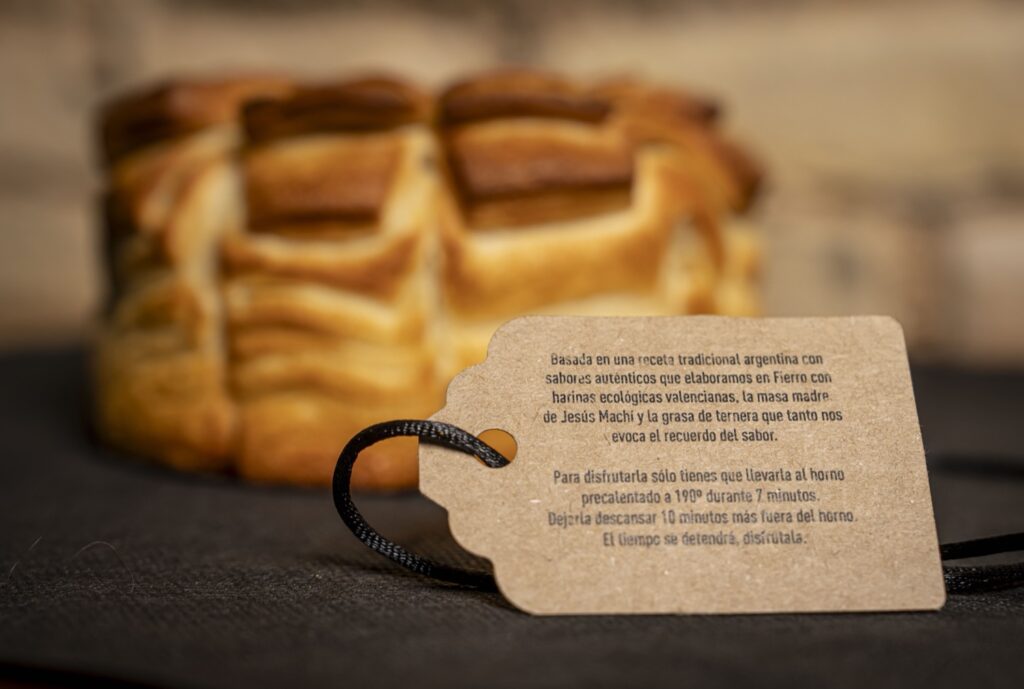
From an Argentine bakery to the FIERRO table
For Carito Lourenço and Germán Carrizo, incorporating cremona into FIERRO meant bringing a recognizable element of their native culture to the restaurant—not as a nostalgic reproduction, but as a dish capable of telling the story of who they are, where they come from, and where they cook today.
For Carito, her memories are tied to her grandmother’s house, the aroma of freshly baked bread, and a table where there was always someone stopping by. Cremona was eaten fresh on the first day and toasted for the rest of the week. “You’d make coffee or mate, warm up a little cremona, and top it with butter, dulce de leche, a slice of cheese, or a bit of salami,” she recalls.
It was also part of other everyday moments. His grandfather worked in the workshop he had at home, and during his nap, his grandmother would bring him mate with cremona. She would stay there, chatting with him while he worked on the cars. For Germán, its flaky texture remains linked to the pancakes of his childhood and the breakfasts of his years in Mendoza. Different memories woven together by the same gesture: coming together, keeping each other company, and sharing.
In Argentina, cremona isn’t typically eaten as a bread to accompany a meal. Adding it to the menu therefore required taking it out of its original context and finding a new way to present it. At FIERRO, we developed a version with a higher moisture content and a fluffier interior, made with sourdough and designed to accompany the various courses without losing the flavor that Carito and Germán recognize as its own.
At FIERRO, Argentine roots meet the Mediterranean and take on new forms. Cremona embodies this fusion: it preserves the silhouette of Argentine bakeries and the memory of the tables around which Carito and Germán grew up, but it also speaks to the cuisine and the life they have built in Valencia.
Over time, it became the bread of FIERRO and an expression of our Mediterranean Argentine identity: a vibrant, nonconformist identity that acknowledges the past without getting stuck in it.
From Argentina to Valencia, the cremona continues to serve the same purpose: bringing us together around the table, whether as part of the FIERRO experience or at home.
